Free Online Courses With Certificates: What to Check
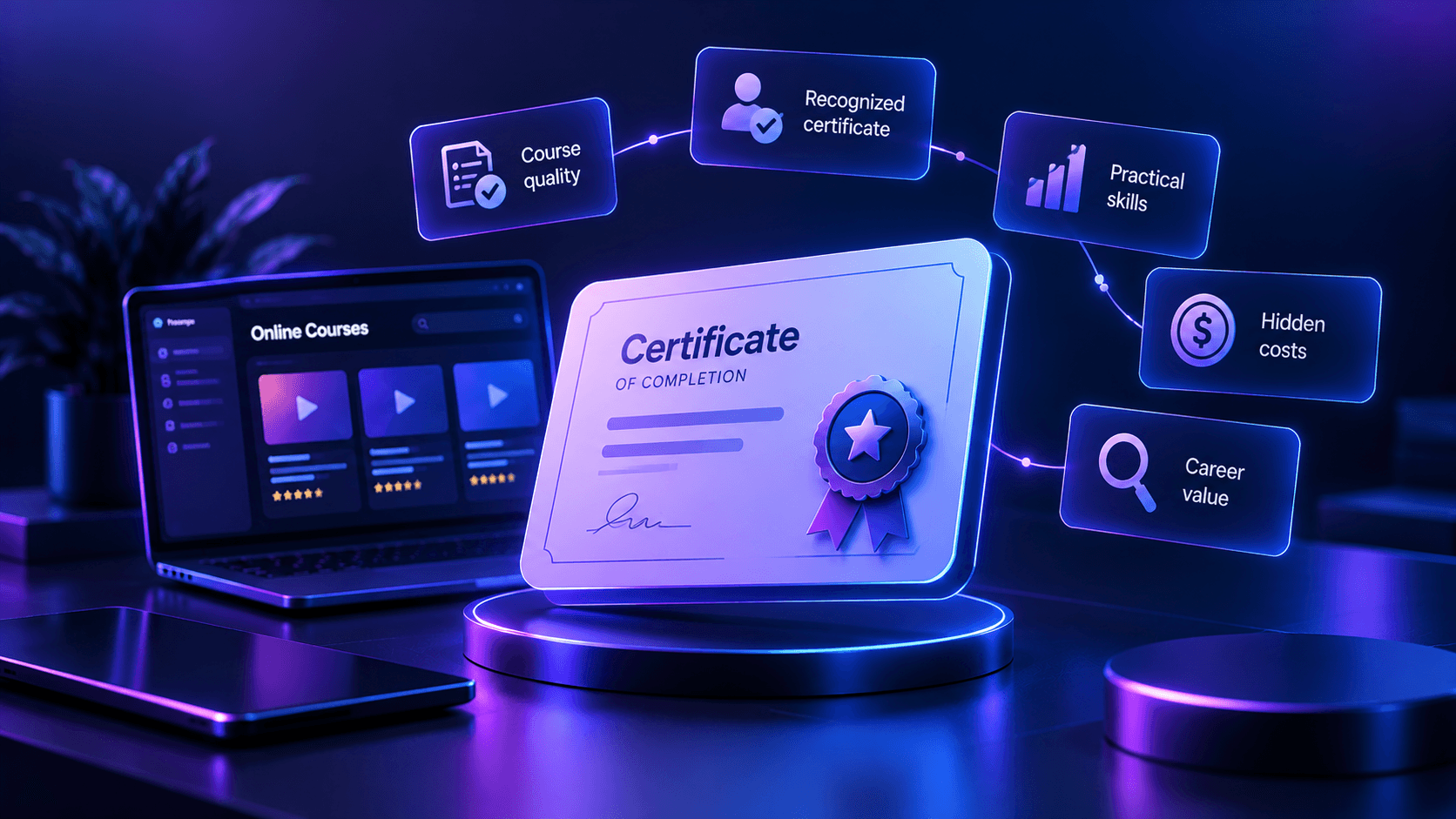
You want evidence of a new skill without committing money you cannot comfortably spend. Free online courses with certificates can sound like the simplest route, but free access and a free completion document are different offers. Before enrolling, check what you can study, what you must complete and whether the certificate itself costs anything.
Separate the lessons from the document
A provider may offer free learning material while charging for assessment or a certificate. Another offer may be a trial that becomes paid unless cancelled. Read the course conditions instead of relying on a search result or a promotional headline.
Coursera's current preview approach provides an initial portion of many courses rather than universal free access to the full programme. A free course preview helps you assess the teaching, but it should not be confused with completing the whole course and earning its associated credential.
Understand what audit access means
On edX, an audit track is a free access option for eligible courses, with restrictions such as limited access periods and excluded graded assignments. It does not include a certificate. Inspect the specific course rather than assuming every programme offers the same route.
A verified certificate is a completion document associated with that provider's verification and assessment requirements. The word verified does not automatically mean the course is an accredited qualification or accepted for academic credit. Check the issuer and what the document actually records.
Check the exact conditions before you start
Read the completion requirements and inspect the offer shown to your account. Ask whether assessments are included, whether access expires and whether a payment is needed before the document becomes available. If financial aid is offered, check the current eligibility and application process rather than assuming approval.
For a trial, note the renewal date and the certificate conditions. Having temporary access to lessons is not the same as receiving a free credential. Compare the full route to your intended outcome before entering payment details.
Make your learning useful without overspending
If you primarily need knowledge, free material may be enough for your first goal. Complete a practical exercise and explain what you learned in your own words. A small programme, a clear analysis or a well-developed creative project can show progress even when you do not purchase a certificate.
If an employer or institution specifically requires a credential, check its acceptance before choosing the course. An attractive certificate that does not meet that requirement can waste time as well as money.
Choose a credible and manageable opportunity
Evaluate the syllabus, prerequisites and teacher's explanations with the same care you would give a paid course. Free access does not remove the need for a realistic schedule. Include time to practise unfamiliar concepts and revisit difficult exercises.
When comparing free online courses with certificates, keep a record of the exact offer and its completion conditions. Choose one relevant course, finish the required work and save an independent example of your skills. That approach gives the learning a purpose beyond collecting documents that say little about what you can do.
Frequently asked questions
Does free enrolment include a free certificate?
Not necessarily. Read the specific offer for assessment access, completion requirements and any certificate payment.
Does edX audit access include a certificate?
No. Eligible audit tracks provide restricted learning access without a certificate. Check the course's current conditions.
Is a course preview the full course?
No. A preview is an introductory access option. Inspect the offer before expecting full materials or assessed completion.
Is learning assistance guaranteed?
No. Availability and eligibility vary. Follow the provider's current process and avoid assuming an application will be approved.
Can you demonstrate skills without a paid certificate?
Yes. Relevant projects and clear explanations can show learning, although a particular employer or institution may require a specific credential.